
From seo traditional to AI Search
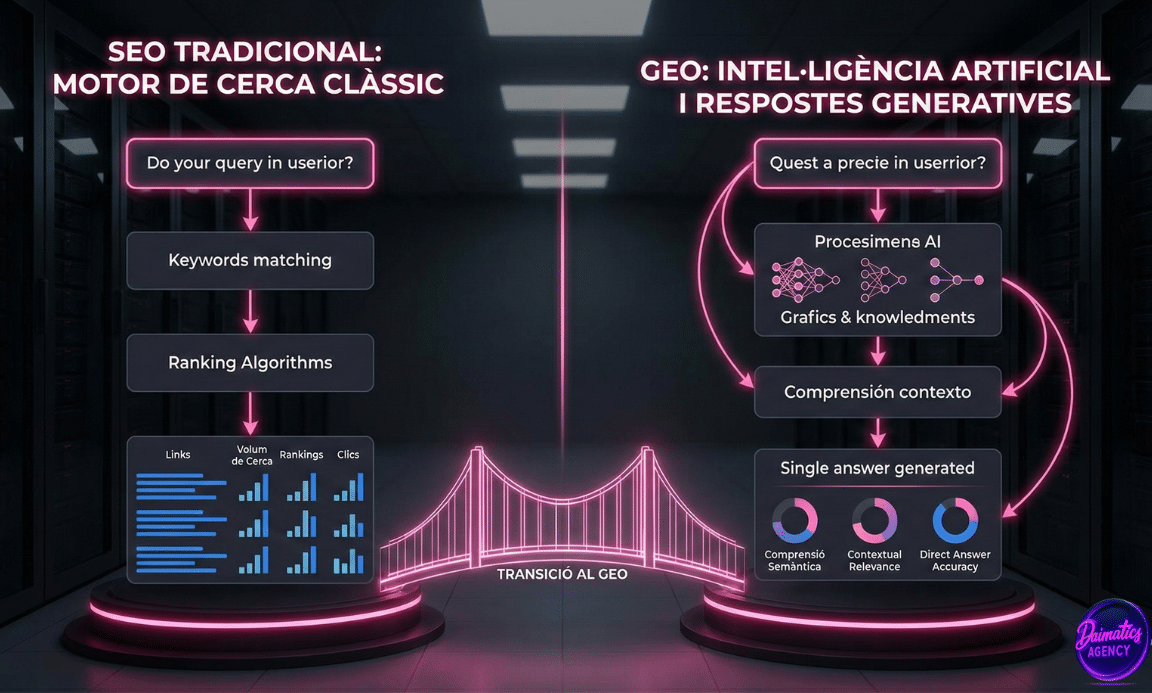
For more than twenty years, the seo has been the dominant framework for building digital visibility. Crawling, indexing, rankings, and keyword optimization have defined the strategy of thousands of companies. But the paradigm is changing.
To better understand this structural change, you can read our guide on GEO (Generative Engine Optimization), where we explain how this evolution redefines digital authority.
It doesn't disappear. seo, but it is no longer the only system for distributing knowledge.
With the emergence of AI Search, AI Overview and systems like ChatGPT, Gemini or Claude, the logic shifts from information retrieval to response generation. And this change is structural.
In seo In traditional environments, Google crawls, indexes documents, and then sorts them according to signals. In generative environments, the system does not retrieve a specific document, but works with embeddings, that is, vector representations of the content.
The difference is key:
- Indexing vs vector representation: Before, you competed to be indexed and well-positioned. Now, you compete to have your content accurately represented within the semantic space of the model.
- Keywords vs semantic density: the repetition of keywords is replaced by conceptual coherence and consistent semantic relationships.
- Ranking vs interpretability: It's not enough to come out first. You have to be interpretable.

Why many brands disappear from generative results
Disappearance in generative environments is not a penalty. It is a logical consequence of the lack of structural coherence. There are four patterns that repeat themselves:- Fragmented content: Isolated articles, without thematic continuity or clear architecture.
- Lack of consistent history: constant changes in strategic positioning without consolidating a narrative.
- Lack of clear entity: the brand is not associated with a specific concept within its sector.
- Keyword-based over-optimization: content designed by old algorithms, not semantic systems.
How generative systems work when selecting sources
Generative models use mechanisms of semantic similarity. When a user asks a question, the system generates a vector representation of the prompt and compares it with internal vectors associated with concepts, documents, and entities. Three fundamental concepts come into play here: Cosine similarity: mathematical measure that calculates the proximity between vectors. The closer the representation of your brand is to the concept being consulted, the more likely it is to be cited. Grounding budget: Systems have a context limit and must select relevant sources within that budget. They cannot include everything. Overall consistency: The model prefers sources with cross-sectional coherence, not point-specific content. When a brand is cited repeatedly in similar contexts, its likelihood of being reused as a reference in future generations increases.
The big problem: you don't know if the AI is dating you
In seo Traditionally, we have Search Console, impressions, clicks and CTR. In AI Search, this layer of visibility is opaque. Search Console does not detect citations in LLM. There is no native metric that indicates whether ChatGPT, Gemini or AI Overview use your brand as a reference. Here a new concept is born: AI Visibility. It's not just about traffic. It's about knowing if you're part of the generative story. To delve deeper into this concept, you can check out this guide on how to measure AI visibility.How to start measuring your presence in AI Search
Measurement is essential. Without data, there is no strategy. The first steps include: Monitoring by prompts: define strategic questions and analyze if your brand appears. Brand monitoring in LLM: repeat queries in different generative environments. Citation history: record evolution and frequency. Specialized tools: use one AI Search monitoring tool that allows you to measure visibility in generative environments and monitor if ChatGPT mentions your brand. The measurement is not specific. It must be recurrent and comparative.Strategic conclusions for companies
The shift to AI Search is not a temporary trend. It is a structural evolution of the knowledge distribution system. Companies that want to remain relevant must adopt four principles: Continuity: publish on a sustained basis. Thematic architecture: structure content into coherent clusters. Constant update: reinforce and expand existing content. Recurring measure: analyze visibility in generative environments. If you want to know if AI is citing your brand, start by measuring it. Measure your visibility in AI Search with a specialized tool.Do you want to know if AI cites your brand?
Measure your presence in generative environments, detect citations and understand your real visibility in AI Search.
Access the toolMonitor how you appear in ChatGPT, AI Overview and other generative environments.